
Weaving MES System · End-to-End Digitalization for Water-Jet, Air-Jet and Rapier Looms
Covering the five core processes of "warping → sizing → drawing-in → weaving → greige inspection and warehousing"; ✨ Integrated with our proprietary light-beam warp breakage detection device: alarms in 0.3 seconds and pinpoints the exact broken warp end; looms per operator rise from 25 to 40, and defective fabric falls by over 60%. Built around the textile-native Zhisuo AI voice assistant, with 10 languages and a card-style PDA mobile app, it deploys directly in overseas mills and lets owners manage the entire plant in real time from their phones.
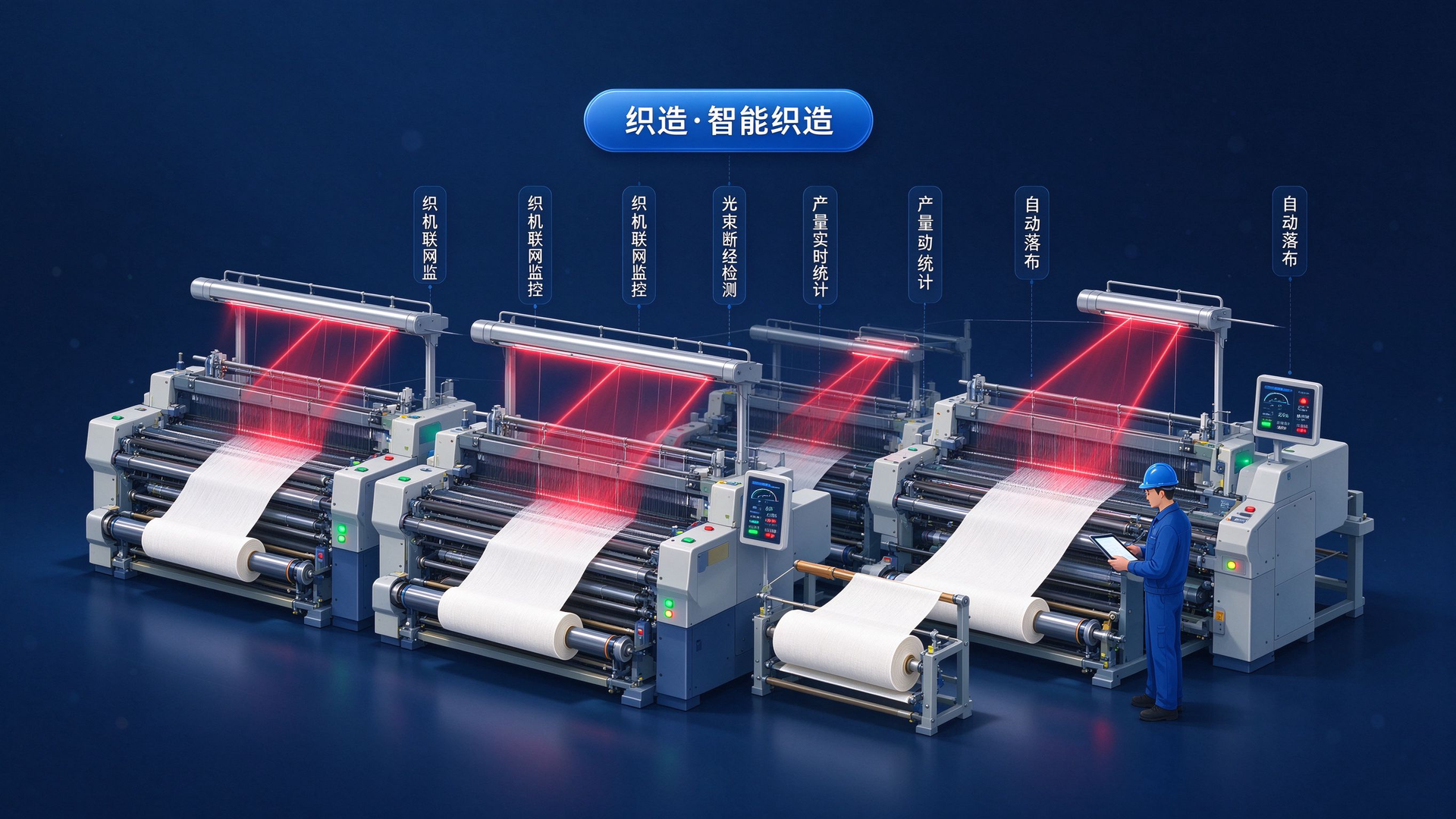
Smart Weaving Workshop Scenario
Water-jet, air-jet and rapier looms are networked plant-wide; beam warp detection triggers a linked stop within 0.3 s, while OEE, output and piece-rate wages appear live on one dashboard.
Run Your Weaving Shed by Voice — Built-In Textile-Native AI Large Model
Features no traditional weaving MES offers: loom operators, shift leaders, plant managers and owners can use it simply by speaking — no menus to memorize and no operation training needed.
Voice Queries Across Every Weaving Module
Ask "how many meters of fabric did we weave today", "which loom has the lowest efficiency" or "how many warp breakages did Loom No. 3 have this month" — results appear in seconds.
AI Anomaly Root Cause Analysis
Ask "why is Vessel No. 3's rework rate so high" or "why are there more warp breakages on the night shift" — the AI automatically correlates raw material, process, temperature/humidity and shift data to deliver the Top 3 causes.
One-Click AI-Generated Reports
Say "give me last month's first-pass success rate report sorted by shift" — an Excel file is generated automatically and sent to management; owners can query reports by voice.
Multi-Turn Dialogue + Colloquial Understanding
Supports vague phrasing, everyday speech and industry jargon; follow up with "what's this loom's history?" and the conversation context is expanded automatically.
Voice Queries in 10 Languages
Chinese, English, Japanese, Kazakh, Vietnamese, Malay, Indonesian, Arabic, French and Russian — ready to use directly in overseas weaving mills.
Strict Read-Only · Data Security
The AI is strictly read-only: it cannot modify data or issue machine commands. Sensitive fields (costs/wages) are isolated by account permissions, and any unauthorized access is blocked automatically.
🎯 Four Typical Pain Points in the Weaving Shed
Traditional weaving floors rely heavily on paper traveler cards and manual patrols by loom operators: warp breakage stoppages are responded to slowly, the true running time of looms is recorded inaccurately, and batch traceability means digging through ledgers, often taking hours.
Delayed Response to Warp Breakages
Conventional drop wires easily rust and stick together. With each operator tending 24–48 looms, abnormalities are spotted late, and looms "running empty" cause the effective running rate to be understated. ✅ Solution: 0.3-second alarms pinpointing the exact broken warp end
Paper Traveler Cards Are Easily Lost
Warping lot numbers, sizing beam numbers and drawing-in records are handwritten on cards; once a card is lost or soiled, batch traceability means hours — sometimes more than a day — of searching through shop-floor ledgers. ✅ Solution: 7-level one-code traceability, located in 1 minute
Piece-Rate Wages Calculated Manually
Output, style coefficients and quality deductions are recorded by shift leaders and then re-entered into Excel, making month-end calculation labor-intensive, dispute-ridden and slow to pay, and hurting worker satisfaction. ✅ Solution: automatic calculation; workers check wages anytime on their phones
No Ledger for Material and Spare-Part Consumption
Requisitions of reeds, healds, drop wires and sizing auxiliaries are incompletely registered, leaving root-cause analysis of abnormal loom wear and abnormal warp breakages without material-dimension data support. ✅ Solution: AI auto-correlates the Top 3 root causes
⚙️ Core Functions · All 12 Modules Covered
Modules can go live in phases according to the company's current situation: Phase 1 starts with weaving production reporting plus the warp-breakage dashboard; Phase 2 extends to warping, sizing, drawing-in, greige inspection and warehousing, and quality traceability.
① Real-Time Loom Monitoring
Real-time monitoring of running/stopped/standby/fault states; real-time capture of speed, efficiency and output; automatic logging of warp and weft stops; electronic shop-floor dashboards; anomaly alerts pushed to mobile phones.
② Warp Breakage Detection Linkage (Core Patent)
Integrated with our proprietary light-beam warp breakage detection device, Alarms in 0.3 seconds, pinpointing the exact broken warp end; AI analysis of warp breakage causes; looms per operator increase from 25 to 40
③ Multi-Dimensional Output Statistics
Multi-dimensional statistics by loom, shift, date and fabric style; automatic daily/monthly/annual output summaries; output attainment-rate analysis; the AI assistant supports voice queries across any dimension.
④ OEE — Overall Equipment Effectiveness
Automatic calculation of availability, performance and quality rates; early warnings for low-efficiency looms; a real-time OEE dashboard; AI analysis of the Top 3 drag factors.
⑤ Downtime Management
Categorized logging of warp stops, weft stops, material waiting, maintenance and shift changes; automatic downtime totals; AI clustering analysis of frequent downtime causes; closed-loop handling of maintenance work orders.
⑥ Beam Mounting and Completion Management
Full-lifecycle tracking of warp beams; automatic beam-efficiency calculation on mounting and completion; beam quality traced back to raw-material batches and warping/sizing process parameters.
⑦ Style Change Records
Complete records of style changeovers; automatic analysis of changeover time and efficiency; one-click reuse of historical style-change parameters — new hires no longer depend on veteran operators' experience.
⑧ Piece-Rate Wages for Loom Operators
Automatically calculated from style coefficients, meterage, quality scores and warp-breakage response time; workers check personal output and pay anytime on PDA/mobile; wage disputes fall by over 70%.
⑨ Full-Chain Batch Traceability
7-level forward and reverse traceability:Raw yarn lot → warping lot → sizing beam → weaver's beam → loom → greige fabric roll → finished goods dispatch; quality issues located in 1 minute; one-click export for customer audits.
⑩ Zhisuo AI voice assistant
Ask by voice "how much did we produce today", "which loom is least efficient" or "how many warp breakages have there been this month"; available directly in 10 languages, with zero training for frontline workers.
⑪ 10 Languages + PDA Mobile
Native 10-language support (Chinese, Japanese, English, Kazakh, Vietnamese, Malay, Indonesian, Arabic, French, Russian); a card-style PDA mobile interface with buttons ≥44 px; ready to deploy directly in overseas plants, including right-to-left Arabic.
⑫ Owner's Executive Dashboard
PDA-style card UI: view plant-wide output, OEE, downtime, wages and inventory on your phone in real time; manage the factory even on business trips; AI voice gives instant answers.
📈 Quantified Customer Value · Typical-Scenario Projections After 3 Months Live
All figures below are presented on a "typical-scenario projection" basis (internally simulated validation comparing the manual mode with linked light-beam warp breakage hardware); actual results vary with company size and baseline conditions.
🏭 Three Major Application Scenarios
Covering the three mainstream weaving technologies — water-jet, air-jet and rapier — with phased deployment for everyone from small 48-loom mills to group enterprises with 500+ looms.
For: family-style mills with 20–120 water-jet looms. Start with Phase 1 — "weaving + greige inspection + piece rate + AI assistant" — live and delivering results in 3–4 weeks at low investment.
For: mid-size weaving enterprises with 120–360 air-jet/rapier looms; all five processes and 12 module cards go live. Combined with the light-beam warp breakage detection device, loom-tending optimization is most pronounced above 120 looms: 25 → 40 looms per operator.
For: group enterprises with multiple sites, multiple workshops and overseas operations; natively 10 languages + right-to-left Arabic + multi-timezone, supporting export orders and group-level OEE, quality and cost analysis.
🔗 Bundled Solutions and Related Links
Cotton Spinning/Weaving MES can be deployed standalone or combined and connected with the cotton spinning, weaving, printing and dyeing, garment and home textile solutions across the full chain, forming an integrated upstream–downstream data foundation.
🎨 Printing and Dyeing MES System (2,600+ Pantone Color Cards) →
After leaving the weaving mill, greige fabric goes directly into the printing and dyeing process; greige batch numbers map one-to-one to dye-vessel numbers, closing the traceability gap between weaving and dyeing, with ΔE color difference quantified automatically.
🏢 Integrated Cotton Spinning–Weaving–Dyeing & Finishing–Garment–Home Textile Full Chain →
Group-type "cotton-spinning yarn→weaving greige→dyeing color-fabric→garment/home-textile finished product" upstream-downstream three processes unified data base, order-completeness and cost-tier auto-calculation, AI assistant cross-factory query.
💡 Light-Beam Warp Breakage Detection Device (Payback in 1.5–2 Months) →
Non-contact optical warp breakage detection with ≤0.3 s response, pinpointing the exact broken warp end; LoRa data feeds directly into the weaving MES dashboards; looms per operator go from 25 to 40; a 100-loom mill saves RMB 800,000–1,200,000 per year.
🛏 Home Textile MES System (±2 g Filling Accuracy) →
Woven greige fabric moves directly into the home textile cutting, sewing and filling processes; set-kitting traceability plus ±2 g filling accuracy alarms, with one-click export for customer audits.
Digitalizing the Full Weaving Process, from Order Scheduling to Inspection and Warehousing
Work orders flow online through sizing, warping, drawing-in, weaving and inspection; downtime and output data are captured automatically.
Order Intake & Scheduling
Orders are split to looms and shifts, with delivery dates and capacity balanced automatically.
Sizing & Warping
Warp-beam batches and sizing parameters are recorded for source-level traceability.
Drawing-in & Loom Setup
Drawing-in tasks are assigned and verified; loom process sheets are issued electronically.
Weaving Production
Loom speed, stoppages, warp breaks and other machine data are captured in real time.
Inspection & Warehousing
Defect grading is bound to roll barcodes; inspection results feed warehousing directly.
Key Parameter Capture and Control for Weaving
Machine operating parameters are captured automatically; abnormal stoppages and efficiency metrics appear in real time.
| Control Item | Data Capture / Threshold | Notes |
|---|---|---|
| Loom Speed | Real-time capture | Standard speed and actual deviation shown by machine model |
| Operating Efficiency | Summarized by shift / day | Utilization and downtime duration computed automatically |
| Warp-break Stoppages | Count + duration | Linked with the warp-break detector; stoppage causes are traceable |
| Output Statistics | By machine / team | Roll meterage and defect grades aggregated automatically |
Top 3 Questions from Weaving Customers
Demo, deployment and ERP integration — see the FAQ page for more questions.
How do I access the demo? Is the data real?
Is data deployed on-premise or in the cloud? How is data security ensured?
Can it integrate with our existing ERP (Yonyou, Kingdee, SAP, etc.)?
Book a 1:1 Weaving MES Demo Now · Experience the Zhisuo AI Voice Assistant
Within 1 business day of booking, a consultant will respond by phone or on site: on-site diagnosis, demo, typical-scenario projection and AI assistant experience, all in one visit.
🎯 Book a Weaving MES Demo Outgoing Inspection and Traceability System →