
Textile MES Intelligent Management System
From cotton-spinning yarn → woven greige → dyed fabric → garment / home-textile finished product Natively Connected End-to-End Data, not a multi-module patchwork. Modules are pluggable, the AI voice assistant covers all modules, 10 languages native support, full-chain one-code traceability, natively connected with the warp-breakage inspection hardware. Price is only 1/3 of traditional first-tier vendors, fast rollout in 2-3 months.
Product Overview
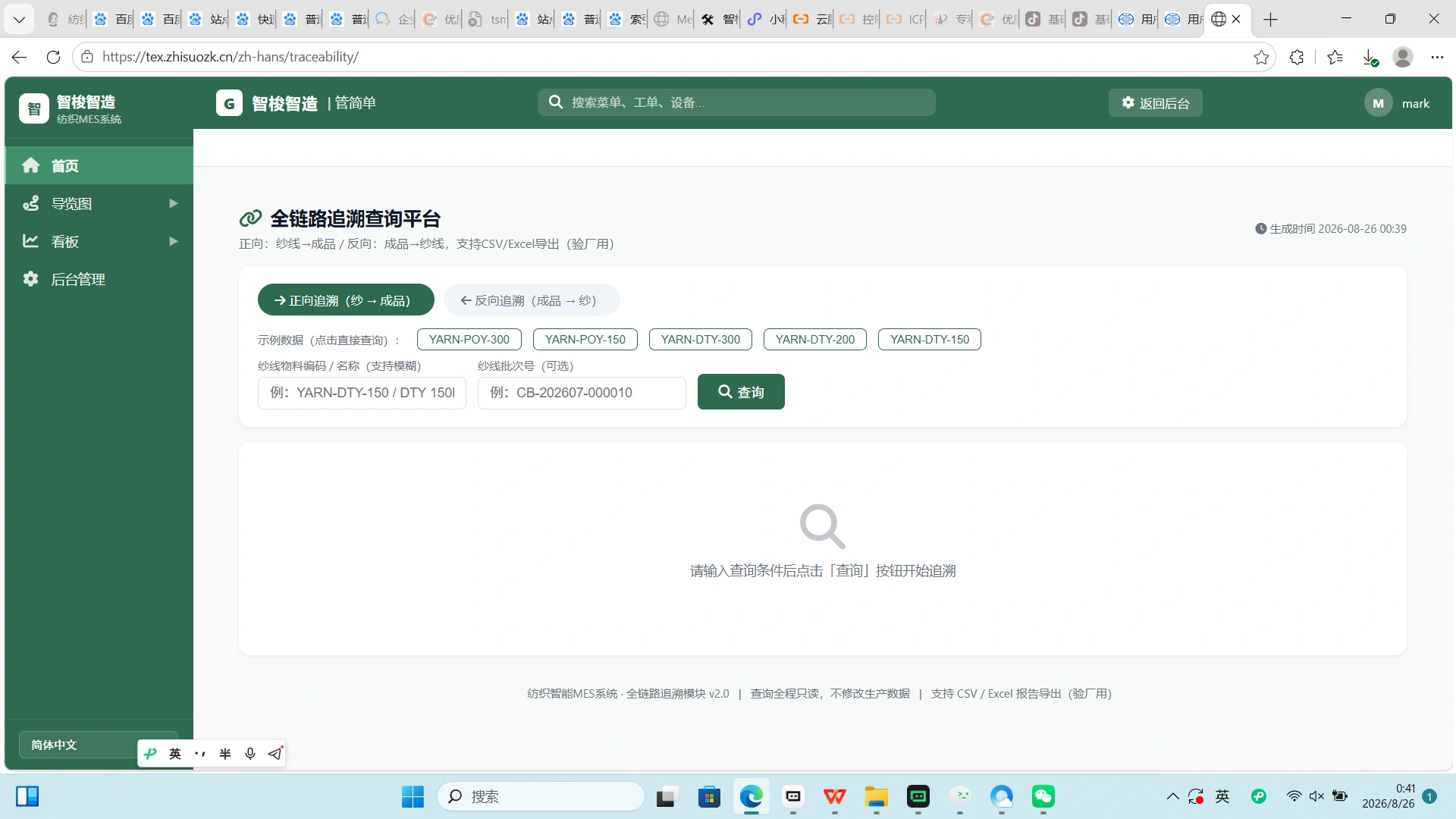
The Textile MES Intelligent Management System is a manufacturing execution platform built for cotton spinning mills, weaving mills, printing and dyeing plants, garment and home textile enterprises. Organized around production work orders, the system provides dedicated modules for five typical scenarios — cotton spinning, weaving, dyeing and finishing, garment and home textile finished goods — and supports the digital flow from sales orders, production planning and shop-floor execution through quality inspection to finished goods warehousing. It natively supports 10 Languages: Chinese, English, Japanese, Kazakh, Vietnamese, Malay, Indonesian, Arabic, French, Russian, with native Arabic RTL (right-to-left) layout adaptation, serving both domestic markets and overseas textile capacity-transfer markets.
Textile MES Workshop Digital Dashboard LIVE
Illustrative data · Not real collection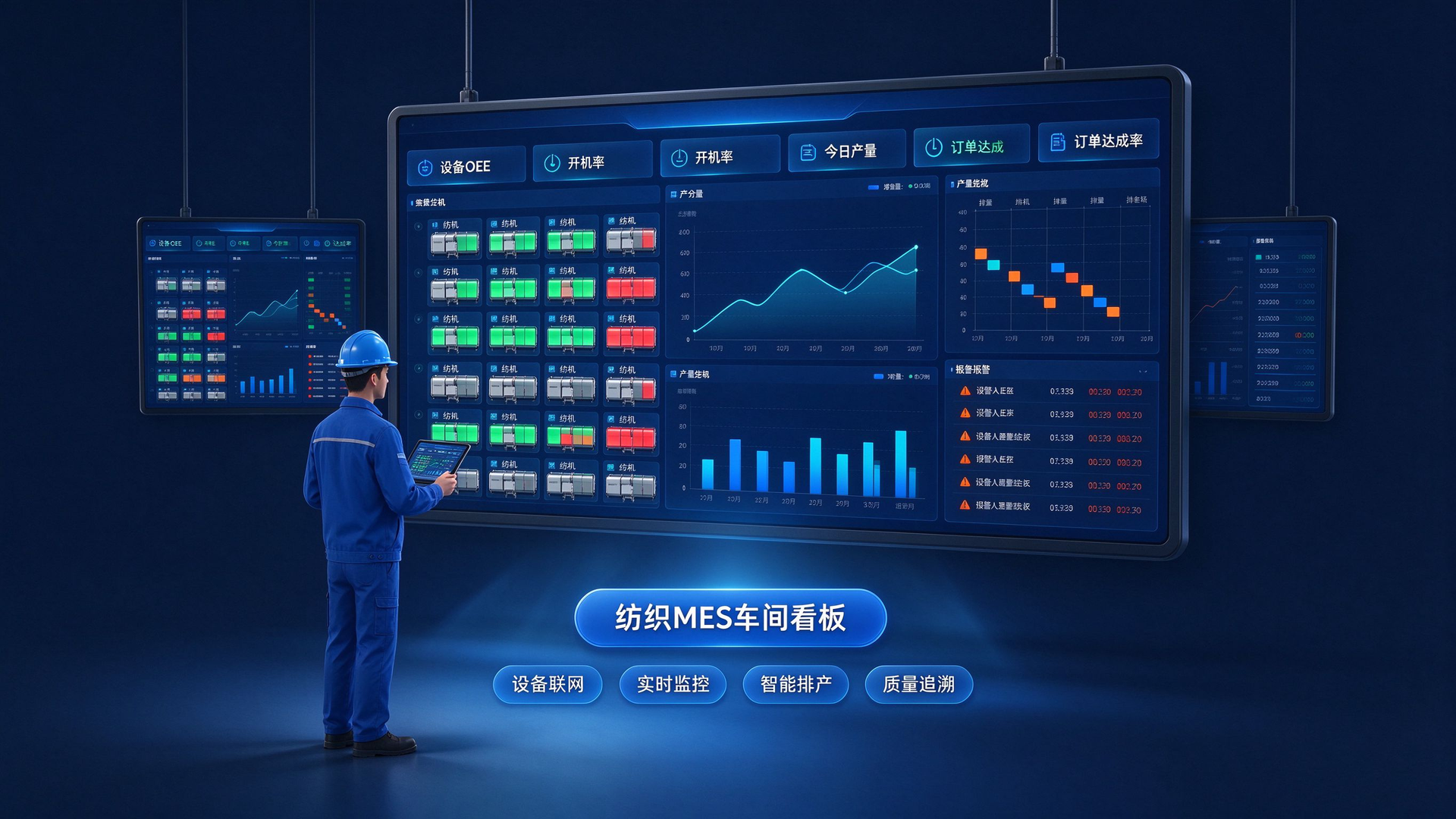
The dashboard below is a functional illustration of the product; all data is static demonstration data, not collected from real operations; the actual interface is subject to project deployment.
Book a demo to see the real system →Why Choose Zhisuo Textile MES — 6 Hard-Hitting Reasons
What traditional industry vendors cannot deliver, we implement for you in one go.
Native End-to-End Connectivity · Not a Patchwork of Modules
From yarn raw materials to woven greige fabric, dyed and finished fabric, and home textile finished products — Underlying Data Model Connected Natively, not several standalone modules stitched together through interfaces. You will never again face the industry-wide headaches of "weaving data never reaching dyeing and finishing" or "home textile unable to trace the weaving yarn batch".
Pluggable Module Architecture · Pilot First, Scale Later, No System Replacement
Buy only the modules you need: get the weaving workshop dashboard running first, then add dyeing and finishing, home textile, equipment management and ERP integration — No System Replacement, No Data Migration — avoiding the traditional vendor trap of "phase one, phase two, phase three, endless system replacements".
Zhisuo AI Voice Assistant Covers Every Module · Industry First
A textile-native AI large model is built in — no menus to memorize and no operations to learn: Just Speak to Pull Data, Build Reports and Pinpoint Problems. Loom operators, plant managers and owners alike can use it simply by speaking. Voice queries work directly in 10 languages, so overseas plants can use it too.
Full-Chain Single-Code Quality Traceability · Ready for Factory Audits
From raw yarn batches to warp beams, weaver's beams, greige fabric rolls, dyeing and finishing lot numbers and home textile bedding sets — Single-Code Forward and Reverse Traceability, End to End. Customer factory audits and export commodity inspections are covered with one-click traceability report exports, so overseas buyers pass on the first attempt.
Natively Integrated with Warp Breakage Detection Hardware · Software-Hardware Closed Loop
Warp breakage events, response times and the exact broken warp end number from our self-developed light-beam warp breakage detection device Streamed Directly into MES Dashboards via LoRa Gateway, automatically calculating per-loom OEE and loom operator efficiency and powering AI root cause analysis of warp breakages — something pure-software competitors cannot do.
Just One-Third the Price, Live in 2-3 Months
Compared with traditional first-tier vendors, whose MES projects routinely run into the millions with implementation cycles of six months or more, the Zhisuo solution Software licensing fee under one-third of theirs, and typical scenarios Go live and see results in just 2-3 months — affordable even for small and mid-sized mills.
Run Your Factory by Voice — Built-in Textile-Native AI Large Model
A feature no traditional MES/ERP offers: whether you are an owner, plant manager or loom operator, you can use the MES simply by speaking — no menus to memorize, no operations to learn.
Voice Queries Across Every Module
Output, inventory, orders, equipment status, quality statistics and batch traceability — just ask out loud and get results in seconds
Multi-Turn Dialogue + Context Understanding
Understands colloquial phrasing, fuzzy questions and technical terminology; ask "why" as a follow-up and the analysis unfolds automatically
AI Anomaly Root Cause Analysis
Ask "why is the rework rate of dye vat No. 3 so high" and the AI automatically correlates weighing errors, dye batches and process temperature to deliver the Top 3 causes
One-Click AI-Generated Reports
Say "give me last month's first-time success rate report sorted by team" and an Excel file is generated and pushed out in seconds
Native 10-Language Voice Queries
Chinese, English, Japanese, Kazakh, Vietnamese, Malay, Indonesian, Arabic, French, Russian
Strict Read-Only Permissions · Data Security
The AI can query but never modify; sensitive fields are isolated by account permissions, and unauthorized data is masked automatically
Core Functions (12 Major Modules, Pick What You Need)
Weaving Scenario Support
Upstream texturing, warping, slashing, beam combining and drawing-in, plus real-time loom dashboards and data integration, linked with warp breakage devices
Dyeing and Finishing Scenario Support
Deep integration of 2600+ Pantone TCX color cards, a dye recipe library, lot-based production and quantified color difference ΔE control
Home Textile Finished Goods Scenario Support
Cutting, sewing, down filling (±2 g precision alarm), quilting, finishing and packaging reporting, plus complete-set bedding traceability
Full-Chain Batch Traceability
Yarn batches, warp beams, weaver's beams, greige fabric, dye vats and finished bedding sets: 7 levels of forward and reverse traceability
Barcode-Based Warehouse Management
Barcoded raw material, semi-finished and finished goods inventory; PDA barcode scanning for inbound and outbound, with storage location binding
Equipment Maintenance + OEE
Equipment ledgers, maintenance records and inspection reminders; automatic availability / performance / quality calculation with alerts for low-efficiency looms
Closed-Loop Quality Management
4-point system, GB2828 sampling, defect records, fabric mending closed loop, and full rework and repair audit trails
Automatic Piece-Rate Payroll Calculation
Piece-rate wages calculated automatically by process, output and team; workers can check them anytime on the PDA mobile app
Safety and Environmental Management
Safety production ledgers, environmental records and hazardous waste management, with one-click export of factory audit documentation
PDA Mobile Terminal
Card-style PDA mobile interface: reporting, scanning, defects and warehousing all done on the phone — frontline workers get started with zero training
Executive Cockpit
PDA-style card UI showing plant-wide output, inventory, profit and OEE on your phone in real time — manage the factory even on business trips
Zhisuo AI Voice Assistant
10-language voice queries + AI root cause analysis + automated reports — run your factory by voice
Work-Order-Driven Closed Loop (Typical SOP for the Weaving Scenario)
Taking a typical work order in the weaving workshop, the following 6 steps are the recommended flow for standard platform deployment; dyeing and finishing and home textile workshops are tailored to their own processes, and the project implementation blueprint governs in each case.
Order Entry
Sales orders capture customer, fabric specifications, quantity and delivery date, then are automatically pushed to the scheduling pool; MRP runs according to customer-configured rules.
Production Scheduling
Schedules production against warp beam, loom and dye vat capacity and priorities, with exception handling for rush order insertion, order changes and suspended orders.
Process Execution
Three channels — loom PLC, warp breakage device and PDA scanning — report output, downtime and warp breakages; dyeing parameters and color difference ΔE are entered per dye lot at the vats.
Quality Inspection
4-point scoring, GB2828 sampling, and defect records tied to fabric rolls and dye lots; the AI pushes the Top 3 causes automatically, with a rework closed loop.
Finished Goods Warehousing
Qualified fabric rolls and bedding sets are scanned into stock and bound to storage locations; batch records and traceability QR codes are generated automatically.
Outbound and Shipping
Goods are picked against shipping orders by scanning and verified at outbound; traceability codes are retained, supporting reverse factory audits by SN / batch number when customers visit.
Core Capabilities
Typical Scenario TailoringTypical Scenario Results Reference
Internal Simulation + Pilot EstimatesAll figures below are joint estimates from Zhisuo Zhikong internal simulation testing and typical pilot scenarios. Actual results vary with workshop scale, loom models, completeness of baseline data and team execution discipline, and are provided solely for selection reference.
(Typical Scenario Estimate)
(Typical Scenario Estimate)
(Arabic RTL)
Weaving Mills
Typical workshops with 500-5000 looms, where networked looms and warp breakage detection work in concert with production management
Printing and Dyeing Plants
2600+ Pantone TCX color cards, recipe library and ΔE color difference control, making the dyeing first-time-through rate (FTT) fully data-driven
Home Textile Enterprises
Typical production scenarios for comforter inserts, pillow inserts and finished bedding sets, with ±2 g down-filling precision alarms and complete-set traceability
Public Cloud / On-Premise Private Deployment / Edge Nodes + HQ Aggregation (Comparison Table)
All three deployment options are delivery forms of the same codebase, and no capability is artificially cut based on deployment form; the differences below are purely objective dimensions of architecture and data residency, with no comparative wording such as "superior to".
Technical Specifications
Shop-Floor MES × Warp Breakage Detection × Factory Station-Test — Three-End Collaboration
The textile MES is no isolated platform: at the front end, warp breakage detection devices feed real-time loom events; every shipped device passes Station-Test benchmark inspection with permanent SN locking, enabling cross-end single-code traceability by UID.
Non-contact optical warp breakage detection at the loom: ≤0.3 s response with ≥99.9% accuracy; breakage events, response times and downtime reason tags flow through LoRa gateways into MES dashboards and OEE analysis, raising looms per operator from 25 to 40.
Loom control boards, warp breakage devices and other hardware complete ten inspections before shipment, with five-state SN writing permanently locked; this gives the MES side cross-end traceable factory device records and benchmark values — single-code traceability by UID across endpoints.
8 Questions on Selection / Deployment / Customization / Data Integration
FAQ1 · Which loom types does the textile MES support? Are there PLC collection requirements?
FAQ2 · How long does deployment typically take? What needs to be prepared from contract signing to go-live?
FAQ3 · With on-premise private deployment, does all data stay entirely on the customer's own servers?
FAQ4 · With multiple groups and plants, how do you achieve group-wide aggregation without disrupting each plant's local operations?
FAQ5 · When the workshop network is poor, do PDAs and mobile terminals support offline entry?
FAQ6 · Where do the data sources for the OEE dashboard's availability / performance / quality come from?
FAQ7 · For loom operator piece-rate and team performance calculations, is it appropriate to pay wages directly from this system's results?
FAQ8 · What kinds of questions does the Zhisuo AI voice assistant support? Could it accidentally modify data?
Product White Paper · Deployment Checklist · Industry Templates · Request Channels
For managers and technical decision-makers: typical-scenario value, deployment forms, data integration, OEE and traceability, AI voice assistant capabilities, implementation paths and common pitfalls.
A pre-deployment self-check covering server specifications, network topology, PDA selection, dashboard devices and recommended LoRa gateway placement (provided separately for public cloud SaaS and on-premise private deployment).
Typical work-order fields, report templates, dashboard layouts, four-grade and ΔE color-difference parameters, Pantone color-card integration examples for the five major scenarios; for customers to quickly cross-check their own business pre-sale and assess fit.
Click through to the live demo at demo.zhisuozk.cn to experience the weaving-scenario dashboards, traceability and report modules, plus the Zhisuo AI voice assistant; for a dedicated industry-template demo, please reach us via the contact form.