
Zhisuo Drop-Wire-Free Light-Beam Warp Breakage Detection Device
The industry's first non-contact optical warp breakage detection: detection accuracy ≥99.9%, false alarm rate ≤0.18%, response ≤0.3 s, pinpointing the exact broken warp end. The drop-wire-free design requires no re-threading on style changes, raising looms per operator from 25 to 40, with investment payback in 1.5-2 months.
Product Overview
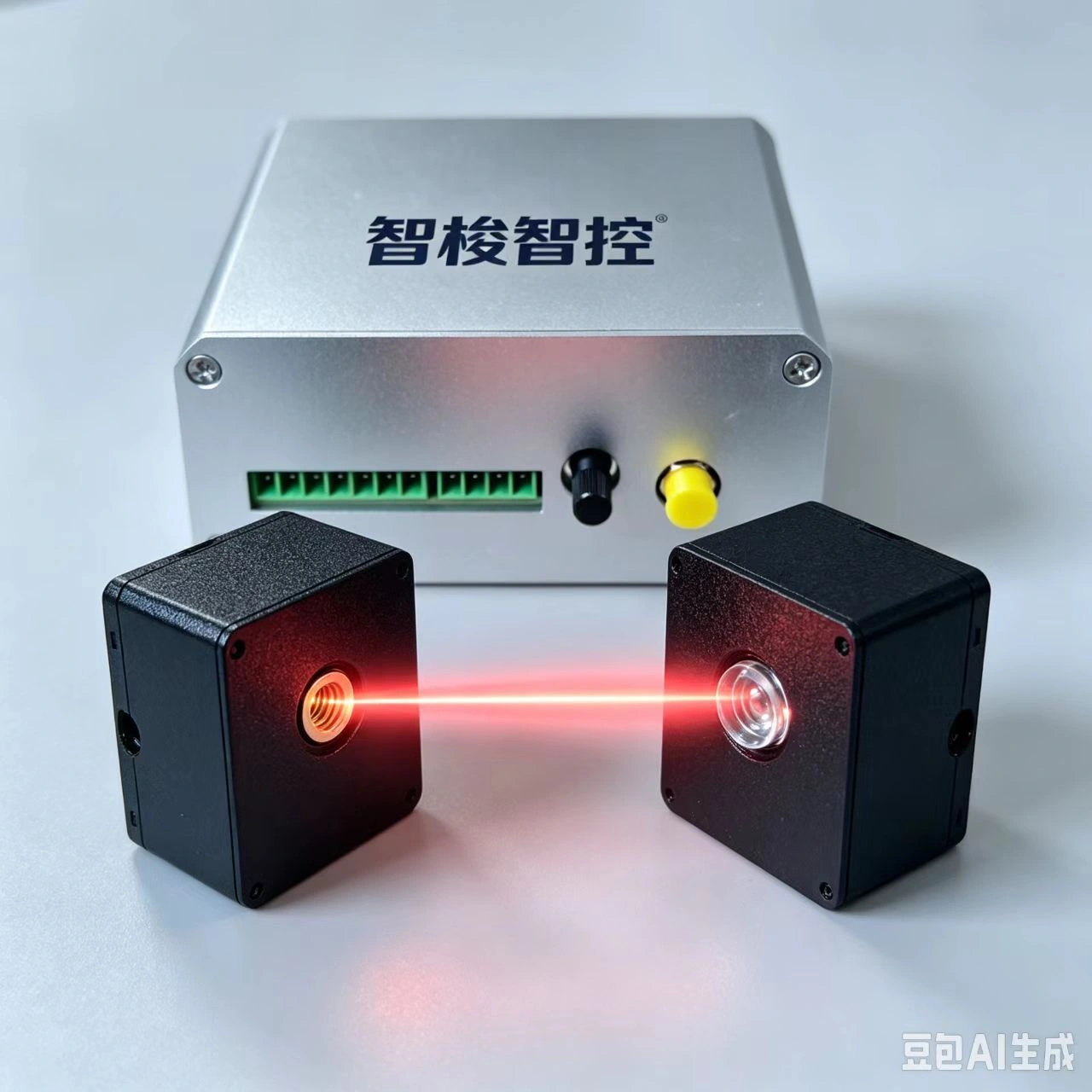
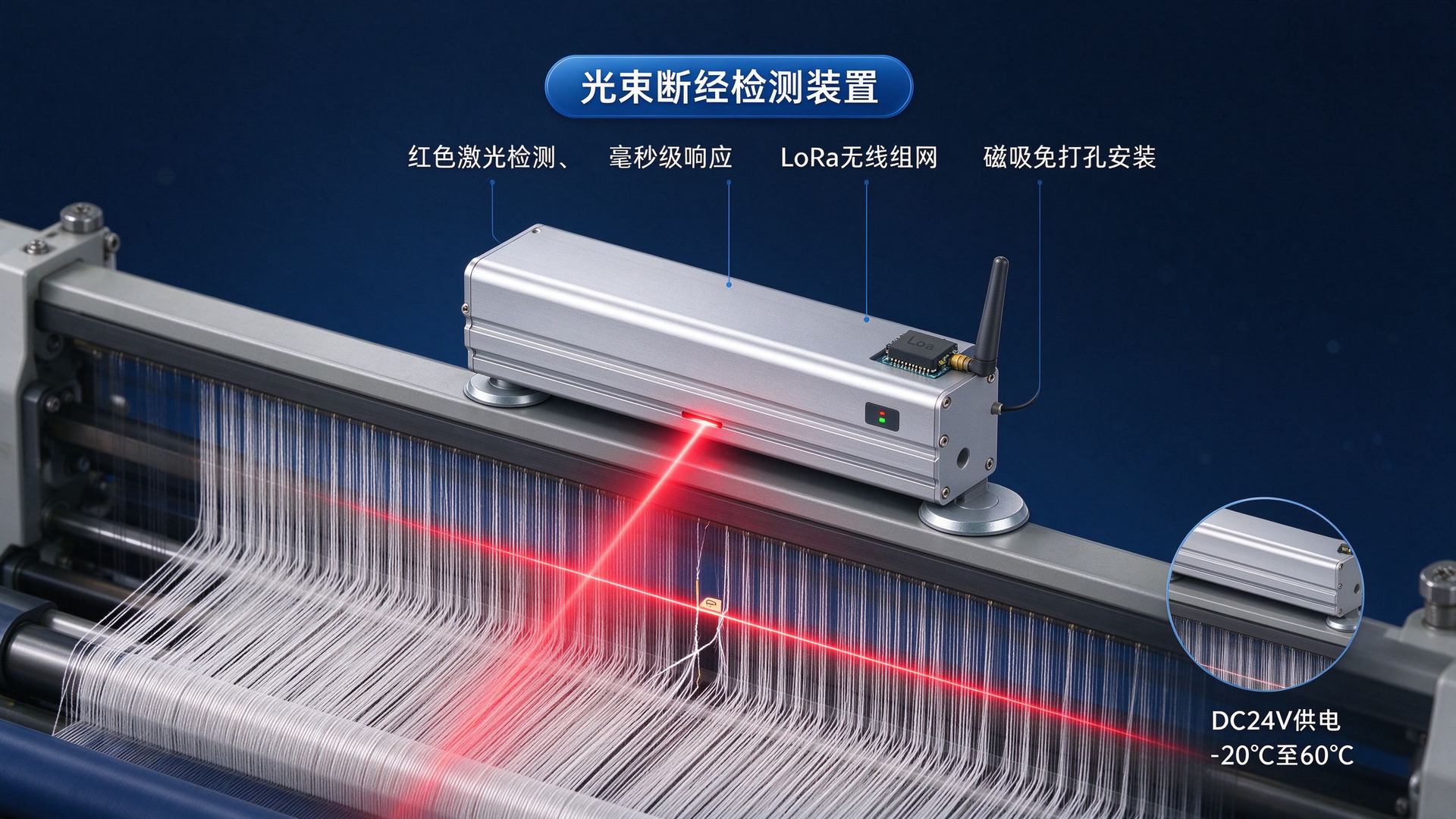
The Zhisuo dropper-free optical beam warp-break detector is a proprietary product of Zhisuo Zhikong (invention patent application No. CN202610310917.4 / application publication No. CN122358386A; the patent application has been published and entered substantive examination). Using our self-developed five-stage winding-displacement motion detection principle, an active beam shines across between the upper and lower warp layers to perform non-contact optical recognition of the five-stage motion of a broken yarn end — instantaneous retraction → random swing → alternating interlacing → self-locking winding → stable displacement. It completely eliminates the mechanical contact of traditional droppers, avoiding warp abrasion and additional breaks caused by droppers, and provides a world-leading warp-break detection solution for water-jet, air-jet and rapier looms, helping improve loom running stability and greige fabric quality.
Key Features
Non-Contact Optical Inspection
An active light beam shines across the gap between the upper and lower warp sheets, exerting no mechanical force whatsoever on the yarn - zero abrasion.
Fast Response Within ≤0.3 s
The loom stops instantly within 0.3 s of a warp break, eliminating long runs of defective fabric and lifting the first-quality greige rate by 20%-25%.
Detection Accuracy ≥99.9%
High-precision optical recognition with a typical-scenario false alarm rate of ≤0.18%, localizing the break precisely to the individual warp end.
Zero Mechanical Wear, Maintenance-Free
No drop wires and no mechanical contact points mean long-term maintenance-free operation with no replacement needed, resisting lint, high humidity and vibration.
LoRa Wireless + MES Integration
Supports LoRa interface networking; warp-break data goes straight to the MES, which automatically calculates machine efficiency and operator output.
Universal Loom Compatibility
Compatible with water-jet, air-jet and rapier looms; fits both new and old looms, installed with N52 magnetic attachment.
6 Hard Metrics, a Return on Investment You Can See
The following are modeled conclusions for a typical customer scenario at a 100-loom water-jet weaving mill; actual results fluctuate slightly with workshop fabric styles, loom speeds and management level.
One-Time Investment of RMB 128K, Net Gain of RMB 0.8-1.2M in One Year
Modeled on real customer scenarios, with figures that stand up to verification: labor cost savings, reduced quality losses and fewer stoppage and rework losses combine into a significant gain.
Not a Simple "Yarn/No-Yarn" Check - World-First Five-Stage Winding-Displacement Motion Recognition
A core patent pool of 10 national invention patents, with a detection principle that transcends traditional approaches - hard capability that competitors cannot replicate in the short term.
Detecting the winding displacement of a broken yarn, rather than a simple "yarn/no-yarn" state
The broken yarn end undergoes a complete five-stage motion: instantaneous retraction -> random oscillation -> alternating interlacing -> self-locking entanglement -> stable displacement. The device shines an active light beam across the gap between the upper and lower warp sheets, capturing the optical signature changes at each stage in real time, and outputs a warp-break signal after comprehensive evaluation, completely avoiding false alarms caused by lint, yarn hairiness and water droplets.
Active light-beam detection - beam shone across the gap between the upper and lower warp sheets, never touching the yarn
The emitter and receiver are positioned on opposite sides above and below the warp sheets; the beam passes through the middle zone between the warp sheets without exerting any mechanical force on the yarn. It withstands the long-term effects of lint buildup, high humidity and loom vibration, and the optical lens needs only one wipe per shift for stable operation.
Drop-wire-free design - no re-threading required on style changes
With traditional drop-wire solutions, every style change requires re-threading all warp yarns through the drop wires one by one - time-consuming, labor-intensive and highly error-prone, and completely unsuited to the fine-count, multi-style, fast-changeover production rhythm of water-jet weaving. The Zhisuo solution offers zero threading action, ready to use the moment it is fitted - an efficiency difference of night and day.
Technical Specifications
Warp-Break Data Connects Directly to the MES, with AI Root-Cause Analysis + Predictive Maintenance
Sensors are not islands: every warp-break event feeds back into management decisions - something hardware-only competitors cannot do.
Warp-break events flow through the LoRa gateway directly into the textile MES, with no manual data entry:
A built-in, textile-native AI large model performs intelligent correlation analysis on historical warp-break data:
Application Scenarios
Water-jet loom workshops
Runs reliably in high-humidity environments, solving the chronic failure problem of rusted drop wires; suited to weaving workshops with 500-5,000 looms
Air-jet loom workshops
Precise warp breakage detection in high-speed weaving scenarios, reducing warp abrasion and lifting the first-quality greige rate
Rapier loom workshops
Equally suited to heavy-fabric and small-batch, multi-style scenarios, with zero threading time on style changes thanks to the drop-wire-free design
Comparison with Traditional Drop Wires
Typical-Scenario Modeling BasisThe comparison data below are joint estimates from Zhisuo Zhikong internal simulation validation and typical pilot customer scenarios. Actual results vary with workshop humidity, yarn count, loom model and worker operating habits, and are provided solely as selection reference.
Intellectual Property
A patent application has been filed for the core technology of this product (application No. CN202610310917.4 / application publication No. CN122358386A, published and under substantive examination), forming a complete patent pool around non-contact optical warp-break detection. Company total: 10 invention patents · all under substantive examination; 1 software copyright registered (registration No. 2026SR1016542), with 2 more under review; 9 utility model patents | accepted and filed; registered technology-based SME; Jiangsu Provincial IP Management Standards enterprise.
Full Outgoing Inspection + Workshop MES | An End-to-End Warp-Break Data Loop
The light-beam warp breakage detection device is no isolated sensor: at the outgoing end its baseline is locked in through Station-Test inspection, and once connected to the textile MES in the customer's workshop, warp-break events, operator responses and associated work orders can be tracked and analyzed on one and the same dashboard.
Before delivery each device completes baseline acquisition and five-state SN programming that is permanently locked; the factory calibration values of a given device and its on-site warp-break events can be cross-analyzed by UID.
Warp-break events, operator handling time, per-loom OEE, associated output and batches flow through the LoRa gateway into MES dashboards and the quality traceability module to support workshop decision-making.
Helping Weaving Enterprises Take the First Step in Smart Transformation, Digital Upgrading and Connectivity
Aligned with the current rollout pace of smart transformation, digital upgrading and connectivity, the data acquisition requirements of industrial internet platforms, and the energy-saving, cost-reduction direction of green manufacturing, the light-beam warp breakage detection device serves as a low-cost entry point for weaving enterprises moving from manual machine patrols to front-end digital acquisition.
Typical smart-transformation scenario
Replacing the purely manual patrols of traditional drop wires, non-contact optical acquisition points are deployed at water-jet/air-jet/rapier looms as one of the lightweight, readily deployable options in the first phase of workshop digital upgrading (typical-scenario estimate; the actual path depends on each enterprise's transformation plan).
Industrial internet data foundation
Warp-break events, machine response times and stoppage-reason tags can all flow through the LoRa gateway into the enterprise's industrial internet platform or self-built MES, forming a foundational data layer on the front-end inspection dimension (integration form depends on the enterprise's actual platform).
Green manufacturing and energy saving
Compared with the consumable consumption and downtime for part replacement arising from long-term wear of metal drop wires, the non-contact, maintenance-free solution helps reduce related material consumption and energy wasted during stoppages (typical-scenario estimate; actual energy-saving results vary with enterprise operating conditions).
12 Questions on Selection / Installation / Use / Maintenance
Compiled from the most frequent questions in Zhisuo Zhikong pre-sales consultations; parameters and conclusions marked as "typical scenario" are all based on internal simulation validation plus joint estimates with pilot workshops.
FAQ1 | How is the "≤0.3 s" warp-break response speed measured? Can it be achieved stably under all operating conditions?
Test conditions (laboratory typical scenario):
At a room temperature of 25°C, with stable DC 24V power, warp ends moving at constant speed through the light path, and using a manually triggered yarn-break simulator, response times were recorded over 1,000 consecutive triggers; the 95th-percentile value was ≤0.3 s, and the higher end did not exceed 0.5 s.
Factors in real workshops that may affect response:
Response time will increase if workshop power ripple is excessive, ambient temperature exceeds the -20°C to 60°C operating range, or lint obscures the optical lens surface. A visual lens cleaning once per shift is recommended (typical-scenario recommendation).
Basis of calculation: "≤0.3 s" is a 95th-percentile result from a laboratory typical scenario, not an absolute-value commitment for every single warp-break event.
FAQ2 | Do the "≥99.9%" detection accuracy and "≤0.18%" false alarm rate cover interference from lint, yarn hairiness, water droplets and lens soiling?
Under typical scenarios (normal speeds on water-jet/air-jet looms, lens cleaned once per shift, workshop humidity 40%-85% RH), over 99.9% of genuine warp-break events with diameter within the detection specification are recognized within a short time and trigger a stop/alarm, with the false alarm rate kept within 0.18%.
Lint, yarn hairiness, water droplets and obvious dust buildup on the lens fall within the scope of routine maintenance and environmental control, and are not covered by the typical-scenario definition above, and are outside the applicability range of the 99.9% metric. Users can minimize such false/missed alarms by establishing a per-shift lens wiping routine.
FAQ3 | What is the exact basis for "zero mechanical wear, maintenance-free"? Does the optical lens not need wiping?
"Zero mechanical wear" is stated relative to traditional drop-wire solutions: this device uses no metal strips/contacts in direct physical contact with the warp ends, so there is neither long-term friction wear between "drop wire and warp yarn" nor replacement cost after strips deform or rust.
"Maintenance-free" is likewise a no-replacement claim relative to drop-wire solutions: once the device body is installed and fixed, wear parts do not need to be replaced loom by loom as in traditional solutions; a simple visual/air-blow cleaning of the optical lens surface once per shift is still recommended (this counts as routine environmental control, not maintenance in the sense of "replacement parts").
FAQ4 | Can it be installed directly on water-jet / air-jet / rapier looms? Does the loom electrical cabinet need modification?
The adaptation package is a three-piece set of "N52/N35 magnetic attachment + DC 24V power take-off + LoRa reporting":
Water-jet/air-jet/rapier looms can be fitted as long as the crossbeam offers a flat magnetic metal surface; where it does not, a custom aluminum alloy bracket can be made (reserved option).
Power is supplied at DC 24V and can be taken from the 24V terminal block in the loom electrical cabinet; No changes to the main control circuit and no insertion into the emergency-stop loop, and the warp-break stop logic is implemented via parallel connection to existing discrete signals.
If the workshop has no LoRa gateway, the device can initially run standalone locally (warp-break events directly trigger the loom brake/stop signal and are recorded in a local log), with gateway access to the MES added later.
FAQ5 | Can LoRa wireless signals penetrate workshop walls? What is the approximate typical coverage distance?
LoRa wall penetration / coverage distance is heavily affected by wall materials, the density of metal equipment, gateway mounting height and on-site interference sources (VFDs / servo motors / welders), so there is no universal figure.
Typical open workshop: with the gateway mounted over 3 m above the floor, stable coverage on the scale of several hundred meters;
Older workshops with many reinforced-concrete partition walls: plan for one gateway per workshop span, or run an on-site wireless survey first.
Zhisuo Zhikong can provide a typical-scenario wireless survey template during the pre-sales phase, and customers can also use standard LoRa test tools to conduct their own on-site assessment.
FAQ6 | Is the power supply DC 24V? What is the wide-voltage range? Will data be lost after a workshop power outage?
Rated DC 24V, with a typical operating voltage range of DC 12V-28V (wide-voltage design, accommodating common 24V supply fluctuations on looms).
The device has a built-in log buffer: warp-break events, timestamps, alarm states and so on are written to local non-volatile memory; after a normal workshop outage and repowering, stored historical logs are not lost. If second-level power ride-through is required, users are advised to select an industrial-grade DC 24V UPS on the loom electrical cabinet side (a user-side option, not standard equipment).
FAQ7 | What is the power consumption? Will a large installation cause a noticeable rise in workshop power load?
Typical consumption of a single unit is ≤0.6 W (standby + normal monitoring), with a peak of ≤1.5 W (millisecond-level) the instant the relay/LED is driven during an alarm.
Estimated for a 1,000-unit workshop: total typical power is <0.6 kW, far below the load of the loom main shafts and VFDs themselves, so it creates virtually no perceptible additional pressure on workshop power (typical-scenario estimate).
FAQ8 | How many looms does one operator currently tend, and can the number of looms per operator increase after installing this device?
The density of looms per operator is affected by multiple factors such as "fabric count / loom speed / number of batches / team management practices / worker proficiency", so the device cannot simply be equated with the basis for staffing management decisions.
In some pilot scenarios, after warp-break events are identified and alarmed quickly and stably, operators can focus more on actual handling rather than frequent patrols, and patrol frequency and walking distance decrease under typical scenarios; in typical pilots looms per operator can rise from 25 to 40, though the actual staffing density is arranged by the enterprise in light of its own team structure.
FAQ9 | What stage is the patent currently at?
The core technology involved is invention patent (application No. CN202610310917.4 / application publication No. CN122358386A); the application has been duly published and entered substantive examination.
· Company total 10 invention patents · all under substantive examination, 1 software copyright registered (registration No. 2026SR1016542), with 2 more under review, 9 utility model patents | accepted and filed.
· Registered technology-based SME; Jiangsu Provincial IP Management Standards enterprise.
· Examination conclusions and grant timing are subject to the official documents of the China National Intellectual Property Administration.
FAQ10 | After the device is connected to the textile MES, which dimensions of warp-break data can be viewed?
Typical integration dimensions (tailorable to customer MES requirements): loom ID / warp-beam lot / shift / operator ID / warp-break timestamp / response handling time / downtime / position of the broken end / whether restart after the stop succeeded.
All the above dimensions come from a combination of the device plus manual MES entry; if the customer does not enter operators and shifts, only the loom + timestamp dimensions are displayed. For more dashboard examples, see the Textile MES product page.
FAQ11 | How does it link with the Station-Test outgoing inspection end? Can the factory baseline of a single device be traced?
Every light-beam warp breakage detection device passes the ten Station-Test inspections before delivery, with five-state SN programming permanently locked, and the written SN is bound to the hardware UID:
If any device at the customer site becomes abnormal, its SN/UID can be used to retrieve the factory baseline acquisition values, inspector, delivery date and corresponding inspection batch;
R&D can conduct cross-end data comparison on devices of the same model and version, helping improve the next generation of optical and firmware parameters.
For the detailed process, see Zhisuo Host-Computer Workstation Inspection System.
FAQ12 | What is the warranty policy? How are firmware upgrades arranged?
Hardware warranty (typical commercial basis; the actual contract prevails):
Free warranty handling is provided for non-human-caused hardware quality issues within 12 months of delivery; human-caused dropping, scratching or unauthorized disassembly of the optical lens, magnets, aluminum alloy housing and so on is not covered by the warranty.
Firmware upgrades:
The firmware upgrade path (if released later) is: Upgrade via OTA through the LoRa gateway, or via the on-site reserved maintenance interface; the binding relationship between SN and UID is not changed during the upgrade.
Note: all service descriptions such as "12-month warranty" and "free warranty" refer to the commercial terms under the contract signed between Zhisuo Zhikong and the customer; the content of this page does not constitute a contractual offer.
Datasheet | White Paper | Installation Checklist
The following materials are official external versions; if you need a more detailed project proposal or installation drawings for specific loom models, please submit your request via "Contact Us" at the bottom of the page, and a solution engineer will follow up.
Includes product appearance images, core specifications, the basis for typical-scenario performance data, compatible loom models and commercial contact information, for print distribution or customer emails.
In-depth explanation covering the five-stage winding-displacement motion detection principle, warp-break response algorithms, LoRa data integration and comparison with traditional drop-wire solutions (aimed at technical decision-makers).
Schematic installation positions, DC 24V power take-off points and magnetic-attachment/bracket options for common water-jet / air-jet / rapier loom models (issued after adaptation to actual models; no generic commercial commitment of "100% compatibility" is made).
Process description and sample labels covering the ten Station-Test inspections, five-state SN programming, permanent locking and QR-code label printing for each device before delivery.